
Employee onboarding process for Modular kitchen studios: showroom, factory and site in the first fortnight
A new designer who has never seen an installation sells layouts that cannot be fitted. A new installer who has never met a customer misreads what matters. The first fortnight should join the showroom, factory and site.
Not sure what you need? Tell us about your business in six short steps and we will come to the first meeting prepared.
Share your requirementsWhy employee onboarding process matters in modular kitchen studios
Most studios put a new designer in the showroom on day one with a brochure and a senior nearby. They learn products but not what happens after the order. The first site visit comes weeks later, by which time something may have gone wrong.
A planned onboarding for a kitchen studio takes each new joiner through the chain: showroom, measurement, factory and fitting. It also introduces the studio's rules for customer conversations, quotation and snags, so that habits start right.
Modular kitchens carry brand-specific knowledge. Hardware makes, laminates, hob and chimney positions and carcass materials each have rules about fit and clearance. A new designer who does not know the clearances or lead times of the studio's own range promises what the factory cannot deliver. Onboarding should teach the range as a working catalogue, not as a brochure.
How to set it up
1. Prepare the joining pack
Include role summary, product basics, quotation format, snag procedure and key contacts. Prepare the desk, login or tools before day one.
2. Show the whole chain
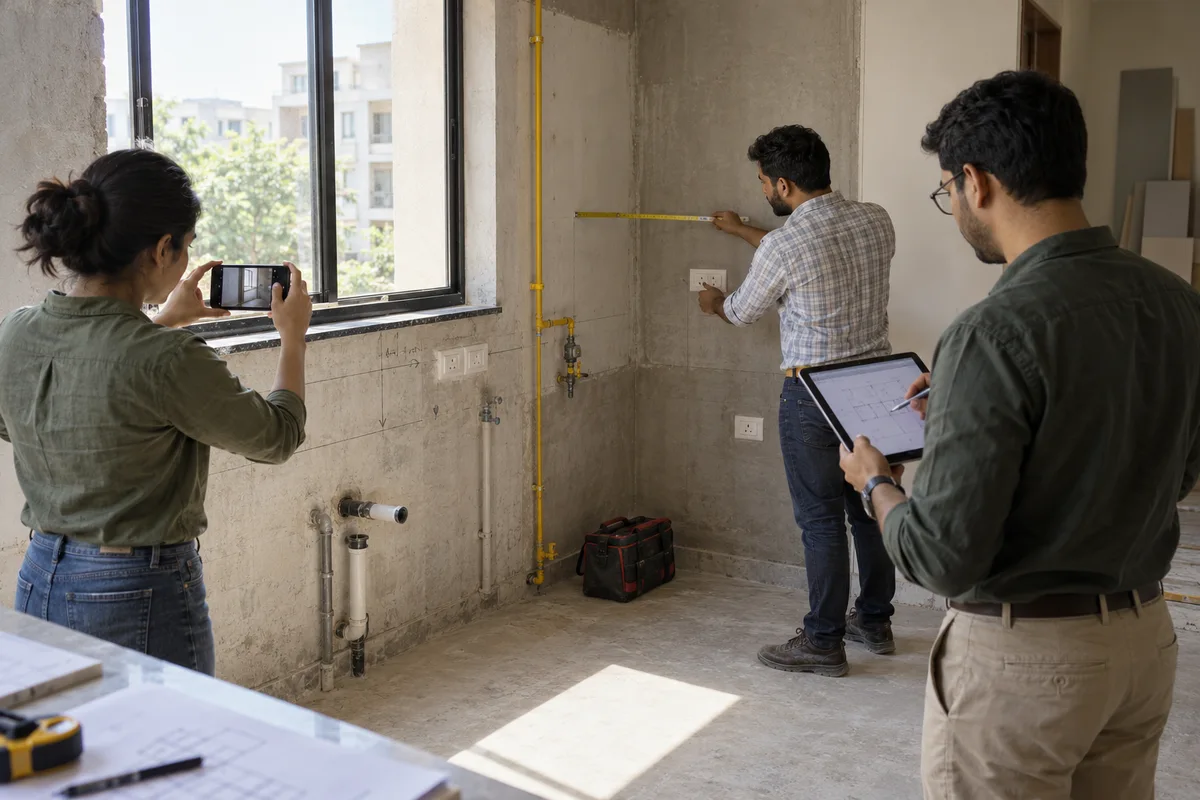
Within the first fortnight, take the joiner to the factory or partner unit and to one site measurement and one installation day. For installers, include a showroom morning.
3. Pair with a buddy
Assign a colleague from the same role for questions and a mentor from another role for the chain view. Meet both weekly.
4. Set early tasks and check-ins
Give small, safe tasks first, such as drafting a layout for review or fitting a single unit under supervision. Hold check-ins at day three, week two and week four.
5. Teach the range with samples
Spend a session with physical samples of shutters, hardware and accessories, noting lead times and what cannot be combined.
6. Practise a measurement visit
Take the joiner to measure a real site, then compare their sketch with the final drawing to show typical errors.
7. Review at the end of probation
Meet to discuss what was learnt, what is unclear and what comes next. Record the outcome before confirmation.
Check these first
Before changing anything, find out what is true today. Use your own records for a defined period and note gaps in the evidence. The review may take longer if records are incomplete or spread across teams.
- Ask the last joiner when they first saw an installation.
- Check that the joining pack has the snag procedure.
- See whether each joiner has a named buddy.
- Look at whether probation reviews were held on time.
- Whether new designers can state the lead time and limits of the main product lines
GullyHR can do this with you. Read how we approach employee onboarding process in general, or share your requirements and we will tell you where to start.
Questions owners ask
Yes. Seeing a kitchen being fitted shows tolerances, services and wall issues, and changes how they design and sell for years afterwards.
Give them the finish standard, a supervisor for the first job and a short checklist. Treat the first job as a trial and share feedback after it.
The core plan runs about two weeks with check-ins through the first month. Probation reviews continue to the end of the agreed period.
Safety, the drawing set, and how to report a site problem. Start with a simple module under supervision before full kitchens.
Give them a shorter version covering the range, the quotation format and the snag routine. They represent your studio to the customer.
We set up the interview and hiring process for modular kitchen studios
Every business interviews, but few have a written process that works the same way for every role and every interviewer. GullyHR designs yours, from the role brief to the offer, trains your managers to run it, and can run it for you on the roles you hand us.