
Get More Than One Option on the Table
For teams that land on the first suggestion and call it a plan. Structured idea generation — written ideation, forced variation, reframing — run against a constraint your business is living with, then narrowed to something you can cost.
When the First Idea Becomes the Decision
A customer asks for a variant you do not make. Someone says no, someone else says we could try, and the conversation ends there. Later a competitor ships it. Most teams do not have an idea problem, they have a shortage of options: the first suggestion in the room becomes the plan because there is no method for producing a second one. This session gives them that method, and applies it to a constraint you are living with now.
What the Session Works On
Reframing the Problem Statement
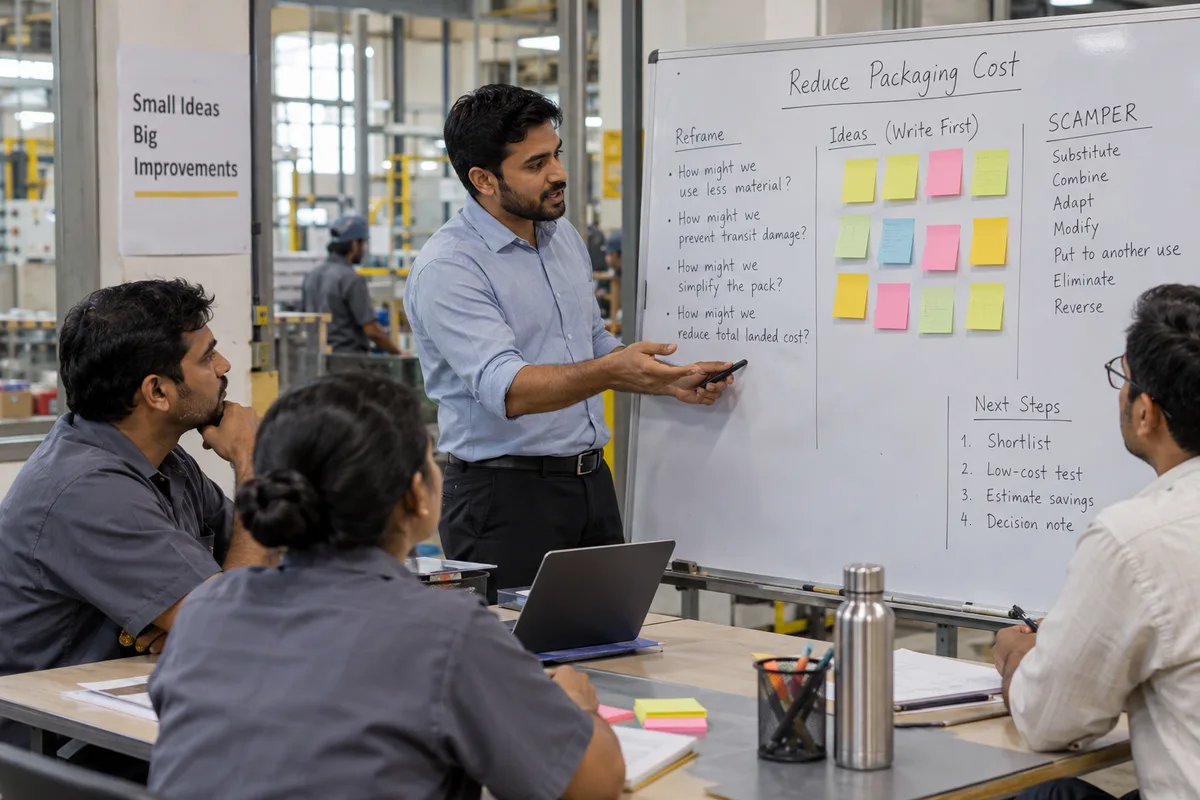
“How do we cut packaging cost” and “how do we stop damage in transit” produce completely different ideas. Participants rewrite a live problem several ways before generating anything, because the framing decides what the room is able to think of.
Written Ideation Before Discussion
Everyone writes before anyone speaks. It is the simplest fix for a room where the senior-most person’s first idea sets the ceiling, and it works with shop-floor teams who will not brainstorm out loud.
SCAMPER on Something You Actually Sell
Substitute, combine, adapt, modify, put to another use, eliminate, reverse — run against a real product, service line or process of yours, so the output is a list you can act on rather than an exercise.
Mind Mapping a Tangled Situation
For problems with too many moving parts: a supplier delay that touches production, dispatch and the customer at once. Getting it onto one sheet so the group can see where the real pressure point sits.
Deliberate Constraints
Ideas sharpen when the brief gets harder: solve it without new headcount, without capex, before the next season. Participants practise using a constraint as a generator instead of treating it as the reason nothing can change.
Narrowing Without Killing
The step most sessions skip. Scoring ideas against effort, cost and reversibility, then choosing the smallest version that would tell you whether the idea is worth more money.
Making the Case to the Person Who Signs
An idea dies in the corridor when it reaches the promoter as enthusiasm rather than as a proposal. Structuring it: what it costs, what it saves, what you stop doing if it fails.
What Participants Are Equipped to Do
Produce a Second and Third Option
The habit of not stopping at the first workable answer, so that a decision is genuinely a choice between alternatives rather than a ratification.
Run Ideation With a Team That Hates Brainstorming
Silent and written formats that draw contributions out of technicians, storekeepers and back-office staff who will not perform in front of a group.
Test an Idea Before It Gets Expensive
Designing the cheapest trial that would settle the question, instead of arguing about a full rollout nobody has evidence for.
Take an Idea to the Promoter as a Proposal
Cost, risk and a stated stopping condition up front, which is what someone signing the cheque needs before they can say yes to anything.
How GullyHR Runs It
Your Constraint, in the Room
We ask for a real problem before we design anything: a line that keeps stopping, a variant customers keep requesting, a cost that will not come down.
No Innovation Theatre
No wall of sticky notes that gets photographed and thrown away. The session ends with a shortlist, a cheapest-possible test for the front-runner, and who is taking it forward.
Built for People Who Say They Are Not Creative
The structure does the work, not personality. Nobody is asked to be spontaneous in front of their own manager.
The Shortlist Goes Home With You
The shortlist their group produced, the reframed problem statements, and the ideation formats written out so a team lead can run the next round without us in the room.
Bring the Problem You Have Already Argued About
We will build the session around a constraint your business is living with, and hand back the shortlist your team produces.
Questions We Get Asked
Scoped per engagement. Generating ideas is quick; narrowing them and building a case takes longer, so we agree the pattern after seeing what you want worked on.
No. Most of what teams bring is operational — shortening a changeover, dealing with a recurring complaint pattern, finding a use for idle capacity, cutting a step out of an approval chain.
Not on its own, and we would rather say so. A session gives people methods and practice; whether ideas survive depends on whether your business funds a trial and tolerates one that fails. If the bottleneck is the approval culture rather than the ideas, we will tell you that at the scoping stage.
Yes, and we prefer it. Bring one you have already argued about without resolving. The session is far more useful when the obvious answers have already been used up.