
Get the Whole Room Solving the Same Problem
For the cross-functional meeting that ends in a longer list of complaints. Practice in framing the problem jointly, hearing the person nearest the work, and closing on an action with an owner.
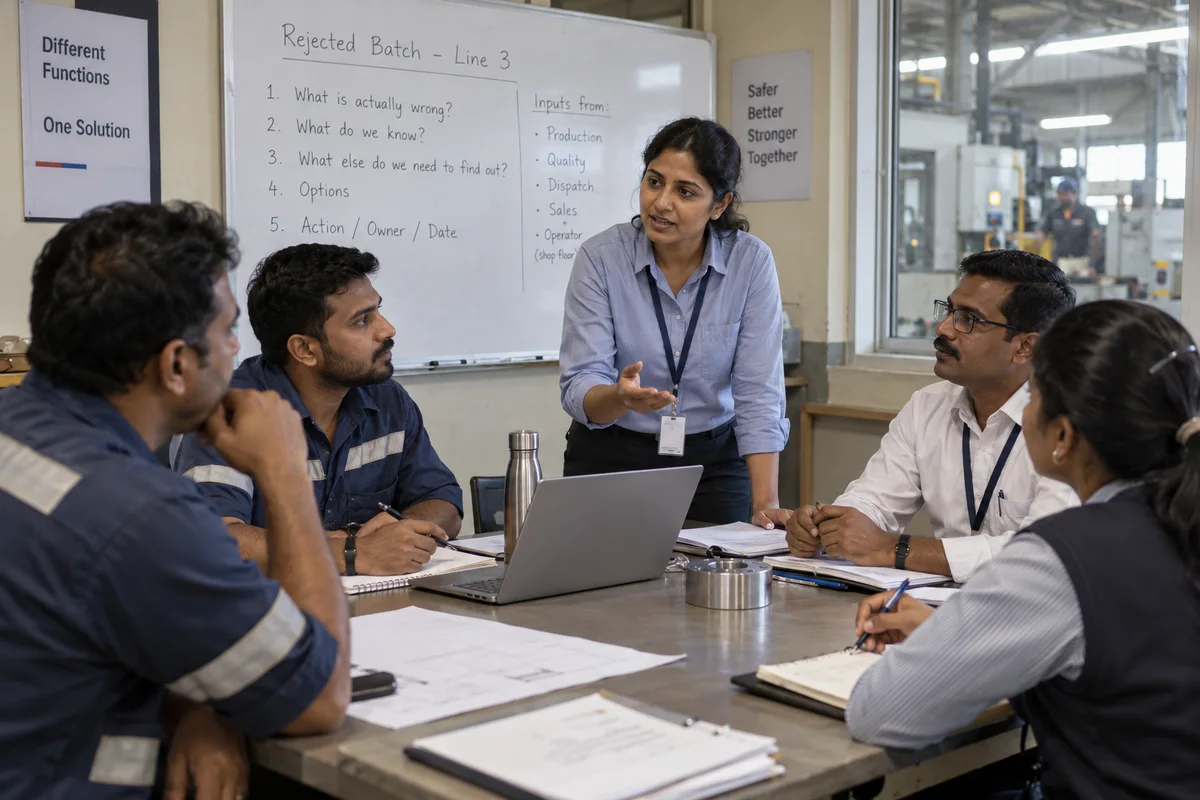
What the Problem Meeting Actually Costs
Production, quality and dispatch sit in the same room about the same rejected batch. The meeting ends with a longer list of complaints and nobody’s name against anything. The operator who has seen the fault before said nothing, because nobody asked him and the loudest voice in the room had already settled it. This session works on that meeting: how the problem gets framed, who is heard, how disagreement is used rather than suppressed, and how the room closes on an action with an owner and a date.
What the Session Works On
Framing the Problem Before Anyone Solves It
The room agrees what is actually wrong before options start. Participants take a live complaint from your business and write one problem statement that production, sales and quality can all sign.
Getting the Person Nearest the Work Heard
The operator, the field technician, the executive who takes the complaint call usually knows something the meeting does not. Practice in asking for that first, before the senior view is on the table.
Structured Group Methods
Brainwriting, fishbone and six thinking hats, used on your problem rather than demonstrated on a case. Written idea generation before open discussion, so the first opinion spoken does not become the group’s opinion.
Facilitating Without Chairing
Holding a discussion to time, stopping the loudest person from settling it, and drawing back someone who has gone quiet. Built for team leads who run these meetings without formal authority over everyone in the room.
Disagreement That Reaches a Decision
Two functions want opposite things and both have a case. Separating the position from the interest under it, testing which one the evidence supports, and closing on something the losing side can still work with.
Live Problem Simulation
Groups work a real recurring problem from your business against a time limit, with roles assigned across functions. The output is a written analysis and an action plan, not a flip chart of ideas.
The Debrief
A structured review after each attempt: what the group did with its quiet member, where it jumped to a solution, what it never checked. The second attempt is where the difference shows.
What Participants Are Equipped to Do
Close a Problem Meeting on an Owner
Participants leave with a way to end a discussion on a named action and a date, so the same issue is not reopened cold at the next review.
Surface the Objection While It Is Cheap
Bringing the floor, the field and the back office into the analysis puts the inconvenient fact on the table before the commitment is made, not after.
Settle Cross-Function Disputes Where They Start
Sales and operations get a shared way to state a problem, so fewer disagreements travel up to the promoter to be decided.
Get Contributions From People Who Will Not Interrupt
Written and silent methods give the quiet technician a way in, without asking anyone to change their personality to be useful.
How GullyHR Runs It
Your Problems, Not a Case Pack
Two or three real, recurring problems from your business become the working material, de-identified where you want them to be. You confirm what may be used in the room.
The Facilitator Watches, Then Feeds Back
Groups run their own discussion while the facilitator observes against a stated sheet. Watching a team solve badly once is what makes the feedback land.
Mixed Cohorts on Purpose
The session is designed for a room holding a shift supervisor and a department head at the same time, because that is the room your problems actually get solved in.
The Facilitation Sequence, Written Down
A facilitation sequence for the next problem meeting, an observation sheet a manager can reuse, and the written action plan their group produced.
Get the Next Problem Meeting to End in a Decision
Tell us the problem that keeps coming back to the same room, and we will build the session around it.
Questions We Get Asked
Scoped at the needs discussion. Group problem work takes as long as the problem needs, so we agree the session pattern once we have seen what you want worked on.
Yes, and that is the intended cohort. The programme is built for the room where production, quality, sales and dispatch have to agree, and the practice problems are chosen so that no single function can solve them alone.
No. This teaches a group a method for working a problem together; it does not resolve a live personal or inter-departmental conflict, and treating it as a substitute would waste your money. Where there is real bad blood, conflict management or a facilitated resolution is the honest first piece of work.
Yes, with breakout groups and the problem statement kept visible on screen throughout. Where a plant or branch team can be in one room together, in person still works better for the group exercises.